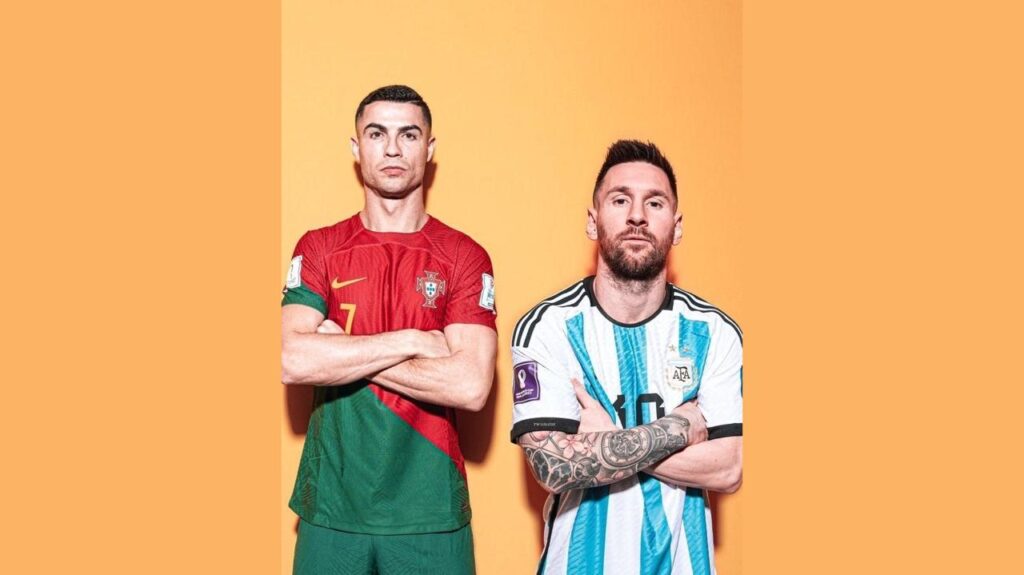
There is a version of the 2026 World Cup that football has been quietly dreaming about since Qatar 2022 ended with Lionel Messi lifting the trophy and Cristiano Ronaldo crying in a tunnel. It is the version where both men, defying age and logic and every reasonable expectation, find themselves in the same knockout bracket one more time. One last collision. One final chapter in the greatest rivalry the sport has ever produced. It may not happen. But it has not stopped being possible, and that possibility alone is enough to make every match Portugal and Argentina play feel like something more than just a football game.
Where they both stand
Messi arrives at 2026 having achieved the one thing that was missing from his story. The World Cup he won in Qatar transformed the conversation around him permanently. He is no longer the genius who could not deliver on the biggest stage. He is the man who delivered on the biggest stage when everything was on the line, in extra time, in a penalty shootout, against France. At thirty-eight years old he is no longer the player who dismantles defences with a dribble, but he remains the player who finds space no one else sees and produces moments no one else can. His body of work is complete. His presence at this tournament is, by any measure, a gift.
Ronaldo’s situation is different and in some ways more complicated. He has spent the years since Qatar playing in Saudi Arabia, a decision that removed him from the weekly scrutiny of European football but did not remove him from the Portuguese squad. He remains his country’s captain, their record scorer, and their most powerful symbol. His numbers in Saudi Arabia have been extraordinary in the way that numbers in that league tend to be, which is to say impressive but not directly comparable. The question around him is no longer whether he can score goals. It is whether, at forty-one, he can still influence a tournament at the level the occasion demands.
The path to a meeting
For Ronaldo and Messi to meet in the knockout rounds, both of their countries need to navigate the group stage and then survive long enough for the bracket to bring them together. Argentina, as defending champions, carry the weight of expectation but also the experience of knowing how to win ugly when it matters. Their squad has evolved since Qatar but the spine remains — a settled defensive unit, Di Maria’s nous even in his later years, and Lautaro Martinez and Julian Alvarez to carry the attacking burden when Messi conserves himself for the moments that matter most.
Portugal have Ronaldo as the figurehead but they are no longer a one-man team, if they ever truly were. Bruno Fernandes runs the midfield with a creativity and intensity that has made him one of Europe’s most influential players over the last four years. Rafael Leao provides the width and pace to stretch any defence. Ruben Neves and Bernardo Silva offer the quality in possession to control matches. This is a genuinely balanced squad, which means that whatever Ronaldo contributes is a bonus rather than the entire plan. That, paradoxically, might free him to produce his best football.
What it would mean
The Messi-Ronaldo rivalry has been the organising principle of football for nearly two decades. It has framed individual seasons, distorted transfer markets, and generated more column inches than any competition the sport has staged. For most of that time it was conducted in parallel — they played in the same league, chased the same records, won the same awards, but almost never faced each other directly with a major trophy on the line. Their World Cup meeting in the same stage would be different. It would be them, at last, on the same pitch, in a knockout match, in a tournament where the prize is the only one neither of them can take from the other.
The theatre of it almost feels too good to be true, which is perhaps why football keeps conjuring the possibility rather than delivering it cleanly. But this version of the story has a dimension the earlier ones lacked: it is explicitly the last time. Whatever happens at this World Cup, it is almost certainly the final chapter for both of them at this level. Messi has said as much. Ronaldo has resisted saying it, but the arithmetic is unforgiving. A meeting here would not just be a football match. It would be the closing scene of the greatest story the modern game has told.
The honest caveat
None of this is guaranteed. Tournaments are complicated, brackets do not always cooperate, and both men are carrying the additional uncertainty that comes with playing deep into your thirties and forties at the elite level. An injury, a poor group-stage result, a quarter-final exit at the hands of an unfancied opponent — any of these could close the story before it reaches its most dramatic possible ending. Football has a long history of not delivering the final it seems to be building toward.
But the possibility is real, and the possibility is enough. Every time Argentina or Portugal take the field this summer, somewhere in the back of every fan’s mind is the same quiet calculation: are we still on track? Is it still possible? That question — sustained across weeks of group-stage football and early knockout rounds — is itself a kind of gift. It means that even before either man has touched the ball in a match that matters, the 2026 World Cup already has its most compelling thread. The last dance may or may not happen. The waiting, though, has already begun.