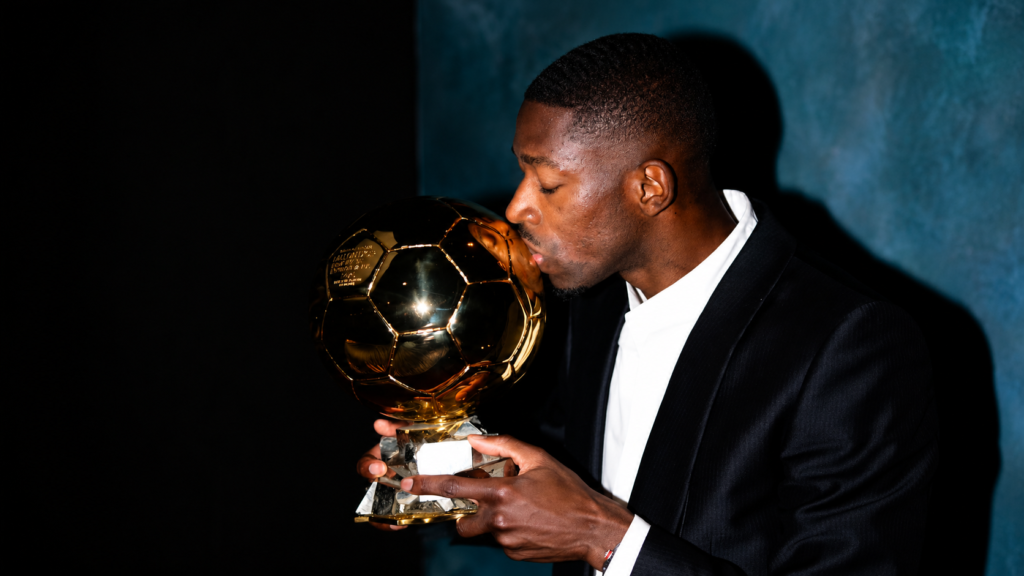
There are players who exist in football’s conversation as permanent nearly-men, talents so prodigious that the game has spent years waiting for the moment when everything clicks into place at once. Ousmane Dembele has spent most of his career in that category. Breathtaking one week, absent the next. A highlight reel without a narrative. But something shifted over the past two seasons, and the player who arrives at the 2026 World Cup with France is not the fragile, erratic winger the world had grown accustomed to managing expectations around. He is something considerably more dangerous: a complete forward in the form of his life, playing for a country that might just be good enough to win the whole thing.
If France go deep in this tournament — and the squad Didier Deschamps has assembled gives them every reason to believe they will — Dembele’s performances will be central to how far they go. And if he produces across seven matches what he has been producing week to week at Paris Saint-Germain, the Ballon d’Or conversation will no longer be an indulgence. It will be a serious, well-founded argument.
The journey to this moment
Dembele’s path to this point has been anything but smooth. He arrived at Barcelona in the summer of 2017 for a fee that made him one of the most expensive teenagers in football history, a direct replacement for Neymar signed with the expectation that he would carry that enormous weight from day one. What followed was a career defined as much by the physiotherapy room as by the pitch. Hamstring injuries, thigh injuries, ankle problems — the list accumulated with grim consistency, and the narrative around him curdled from excitement into frustration.
There were flashes throughout that reminded the sport what it was dealing with. His debut goal for Barcelona against Getafe. The mazy runs that left full-backs clutching at air. A Champions League semi-final performance against Liverpool in 2019 that briefly felt like the arrival everyone had been waiting for. But each promising sequence ended with another spell on the treatment table, and by the time his Barcelona contract wound down acrimoniously in 2022, many observers had quietly filed him under talented but unreliable.
The move to PSG was supposed to be the reset, and it was — but not immediately and not simply. His first season in Paris was encouraging without being transformative. The second was something different entirely. Under Luis Enrique, a manager who had managed Dembele at Barcelona and understood precisely how to frame his responsibilities and his freedom, the winger produced the most consistent campaign of his career. Goals, assists, directness, and crucially matches played. The injury record that had defined a decade of his career was no longer the first thing anyone mentioned. What they mentioned instead was the football.
What makes him so dangerous right now
Dembele at his current level is one of the most difficult forwards in Europe to defend against for a simple reason: he is equally threatening in both directions. The ability to cut inside from the right onto his left foot is familiar to anyone who has watched him over the years, but what has developed under Enrique is the willingness and quality to go the other way, to deliver early crosses, to combine and move rather than isolate and dribble. He has become, in the truest sense, unpredictable — and unpredictability at pace is the quality defenders find hardest to neutralise.
His goal contribution across his best PSG season places him among the elite wide forwards in European football, and the numbers feel honest rather than inflated. He is creating chances in open play, converting them himself, and doing the work without the ball that a team like PSG under Enrique demands from their front players. The physical issues that plagued him at Barcelona have not entirely disappeared, but the management of his body has clearly improved, and a player who stays fit tends to improve. The more matches Dembele plays in sequence, the sharper his football becomes. A tournament structure — with consistent preparation, no rotation, and one match every four to five days — suits him almost perfectly.
The France factor
The Ballon d’Or has always been about more than individual statistics. It rewards players on winning teams. Karim Benzema’s 2022 award, deserved on pure merit, was nevertheless delayed until a Champions League triumph gave the narrative its finishing touch. Lionel Messi winning in 2023 after lifting the World Cup in 2022 was the most complete story the award has produced in years. The voters, no matter what the criteria formally state, respond to triumph.
This is where France’s campaign becomes directly relevant to Dembele’s personal ambitions. Les Bleus enter the tournament with a squad that has genuine depth at every position — Kylian Mbappe in the form of his life and leading the attack, a settled defensive structure, and the midfield quality to control matches against any opponent. They are not favourites simply because of reputation but because of the specific combination of talent, experience, and tournament know-how that Deschamps has built over more than a decade.
If France win the World Cup, the Ballon d’Or conversation will centre on Mbappe first, as it always does. But the award is not necessarily won by the player who scores the most goals for the champions. It is won by the player who leaves the most indelible impression across the entire year. Dembele has already had a brilliant club season. If he then produces memorable performances across a World Cup — a tournament that, by its global reach and emotional weight, amplifies every contribution beyond what club football can replicate — the accumulated body of work becomes extraordinary.
The Ballon d’Or case
The case for Dembele is not hypothetical wishful thinking. It rests on a sequence of logic that football has rewarded before. A player has a career-best club season. He carries that form into a World Cup with a country that wins the tournament. His individual performances are central to that triumph, not peripheral. The voters look at twelve months of evidence and find, when they add it up, that one name sits above the rest not just in goals but in impact, in consistency, in the sheer number of important moments that trace back to one player.
The obstacle, of course, is Mbappe. On the same team, leading the attack, taking the penalties, and arriving at the tournament with a career’s worth of goodwill already banked with the voters, Mbappe will be the default answer for most people before a ball is kicked. Dembele would need to outperform him over the course of the tournament, or at minimum match him while Mbappe has a relatively quiet campaign by his own extraordinary standards. Neither outcome is impossible, but both require a specific set of circumstances to align.
What is clear is that, for the first time in his career, the circumstances are not the constraint. Dembele is fit, in form, and playing in a system that liberates him. The tournament is the opportunity. Whether he seizes it is the question that makes France’s World Cup campaign, even beyond the trophy itself, one of the most compelling sub-plots of the entire summer.
A legacy waiting to be written
Dembele turns twenty-nine during this tournament. He is no longer a young talent with potential; he is a senior player with a point to prove and the ability to prove it. The years of injury and frustration and unfulfilled promise have built up a pressure that, in the right conditions, can become fuel. This France squad, on this stage, in what should be the peak years of his career, represents the precise set of conditions he has been waiting for since he arrived at the Nou Camp as a teenage record signing almost a decade ago. The story of Ousmane Dembele has always been that the best chapter was still to come. The 2026 World Cup is where we find out whether that was always true, or whether it was just the thing people said while they waited.